FAO MEDALS  1976-1977; 1978; 1979       Statement from Raymond Lloyd - FAO money problems

           Rural Women's Advancement - FAO MEDALS

Ceres & Agricola 1976-1977     Silver 50 mm - Gold 28 mm
Farah Pahlavi-Fatima Abdel Mahmoud-Dorothy Nyembe-Julius Nyere-Sirimavo Bandaranaike-Grace of Monaco

  TOP

Dorothy Nyembe

On 21 March 1976, International Day Against Racial Discrimination, the Food and Agriculture Organization of the United Nations (FAO) released the Ceres medal featuring Dorothy Nyembe of South Africa. Born in Natal in 1930, Dorothy Nyembe  is a leader in the women's movement and the struggle for human rights in South Africa. She has been arrested and imprisoned several times. In March 1969, Dorothy Nyembe was sentenced to 15 years' imprisonment under the country's apartheid laws.
This medal portrays Dorothy Nyembe against the prison bars where she will remain till 1984. As symbols of freedom and agricultural advancement, the medal reverse shows hands breaking their chains and supporting a pot in the shape of southern Africa from which maize, a major African crop, is growing.
Michael Hibbit, the British sculptor, designed this inspiring medal, struck in Arezzo by the Gori & Zucchi Mint.
  See also: Dorothy Nyembe -  from South African History Online

TOP

Fatima Abdel Mahmoud
This medal portrays Fatima Abdel Mahmoud as Ceres, surrounded by cotton motifs, a reminder of the importance of this crop to the Sudanese economy. The medal reverse is an inscription of a verse from the Koran: "Work, for God will see the result of your work, and so will His Prophet and the Faithful" (9: 105).
Minister for Social Affairs of the Democratic Republic of Sudan since 1976, Dr. Mahmoud is also involved in many other official duties dealing with peace, social welfare and child care. Dedicated to the activities of Sudanese women in agriculture, Dr. Mahmoud has written several books and articles on population, family planning and women's affairs.
The portrait of Dr. Mahmoud was designed by the Italian medallist-engraver Sergio Giandomenico, and calligraphy for the inscription on the medal reverse is by Abdel Muniem Awed. The Gori & Zucchi Mint of Arezzo struck the medal.

TOP

Julius Nyere
FAO has launched a new series of medals, bearing the word AGRICOLA, the Latin for farmer, to honour distinguished men of our time who have made important
contributions to FAO's Food for All goal. The first FAO Agricola medal features Dr. Julius K.Nyerere, President of the United Republic of Tanzania, on the portrait side. His Ujamaa 'Familyhood' village development programme, promulgated on 5 February 1967 in his Arusha Declaration on socialism and self-reliance, is commemorated with this medallic issue.
The medal reverse summarizes his philosophy: the hoe representing agriculture, while the cogwheel symbolizes industry and the eventual mechanization of present back- breaking farming methods. Sculpted by the British medallist, Michael Rizzello, the medal was struck at the Bertoni Mint in Milan.

TOP

Grace of Monaco
On the portrait side of this FAO medal, Princess Grace of Monaco is shown surrounded by wheat motifs.
Princess Grace is well-known for her longtime dedication to Red Cross activities. The reverse  side of the medal highlights her extensive work with young people. The inscription "For Friends of Young People", in both English and French, recalls Princess Grace's honorary presidency of the World Association of Young People's Friends, an organization founded in Monaco in 1963 which aims at ensuring the physical, moral and spiritual well-being of children everywhere in the world, regardless of race, nationality or religion.
Struck at the Bertoni Mint, Milan, the medal was created by the Italian sculptor PietroGiampaoli, who also designed Italy's first 500 lire coin in 1958.

TOP

Sirimavo Bandaranaike
On the portrait side of the medal, Sirimavo Bandaranaike's pendant is in the shape of Sri Lanka, and she is holding a sheaf of rice. The medal reverse illustrates her concern for a peace zone in the Indian Ocean and recalls the Non-Alligned Summit Conference held in Colombo from 17 to 19 August 1976.
The world's first woman Prime Minister, Sirimavo Bandaranaike of Sri Lanka is a longtime worker in women's movements. Mrs. Bandaranaike was an initial proponent of FAO's International Fertilizer Scheme, whose purpose is, in her words, "to enable developing countries to continue the green revolution" and attain food self-sufficiency. Social welfare is another of her main areas of interest, including free education and medical care, with particular emphasis on women's development and family planning.
The medal was struck by the Gori & Zucchi Mint, Arezzo.

TOP

Farah Pahlavi
On the portrait side of this FAO medal, Farah Pahlavi of Iran is shown wearing jewels made from ears of wheat, symbolic of the goddess Ceres whom
she represents. The medal reverse features a rose motif from a Persian carpet and the inscription: "Who Works the Soil Sings Nature's Legend" ( "Roosta'ee hamas-e  afarin tabi-at ast" (Farsi), calling attention to the Shahbanou's interest in promoting rural handicrafts and developing the land for agriculture.
Concerned with the development of her country and the improvement of the living conditions of her people, Farah Pahlavi devotes much of her time
and energy working on plans for social, educational and cultural reform.
Sculpted by Sergio Giandomenico, a leading Italian medallist-engraver, the Farah Pahlavi medal was struck by the Gori & Zucchi Mint, Arezzo.


Ceres 1978     Silver 50 mm - Gold 28 mm
Lillian Carter-Alpine Shepherdess-Cicely Williams-Food for the Newborn-Pauline Jewlett-Helen Newton Turner 

TOP

Lillian Carter
The mother of President Carter worked for many years as a registered nurse and was one of the first proponents of civil rights in her own community.
MissLillian became a Peace Corps volunteer at the age of 68 and served as a nurse in the town of Vikhroli, near Bombay in India, treating sufferers from
many diseases, including cholera and leprosy.
A portrait of Lillian Carter appears on the medal obverse, while the reverse shows three nurses, black, white and Indian, with the inscription: "Human
kindness and caring - heal beyond any wall".
The medal was sculpted by Frank Gasparro, chief engraver of the U.S. Mint, in his private capacity, and was struck at the Gori & Zucchi Mint, Arezzo.

TOP

Alpine Shepherdess
Ettore Calvelli of Milan, a leading Italian medallist, has created a new Idealized Ceres medal.
A simple shepherd girl, Claudia Tomasi from Ponte di Legno, in the mountains of northern Italy, so inspired the artist with her sweetness and grace
that he portrayed her on the obverse of this medal in an idealized interpretation of Ceres, the ancient Roman goddess of agriculture.
Contrasting with the almost dream-like quality of the portrait of the shepherdess as Ceres is the reverse of the medal. People seated around a poor,
roughhewn table, with the inscription "Fiat Panis" (Food for All), are the figures used by the artist to communicate his message of brotherhood and
solidarity.
The Bertoni Mint of Milan struck the medal.

TOP

Cicely Williams
This FAO Ceres medal features Dr. Cicely Williams, British nutritionist and pediatrician. Born in Jamaica, Dr. Williams began her major work in Ghana, then known as the Gold Coast, where she studied protein malnutrition in infants. This condition was later introduced into medical literature by Cicely Williams with the name of kwashiorkor.
Dr. Williams has devoted more than 50 years to the integration of nutrition with maternal arid child care. The World Health Organization called her in 1948 to head its first Section on Maternal and Child Health. Cicely Williams' work in mother and child health comprises over fifty publications, research and teaching.
Lady Juliet Simpson designed the Ceres medal honouring Dr. Williams. "Food and Health for All" the inscription on the reverse, expresses the shared goals of FAO and this rare practitioner of medicine and pediatrics. The medal was struck at the Bertoni Mint, Milan.

TOP

Helen Newton Turner
Ceres, the Roman goddess of agriculture is represented on this FAO medal by Dr. Helen Newton Turner of Australia, a world expert in animal genetics. Her field of
specialization is the science of sheep breeding, particularly selection in the breeding of the Australian Merino.
Dr. Turner has worked as an FAO consultant on sheep projects, and has given seminars and lectures on her speciality all over the world. She has also been active in
obtaining funds to provide scholarships for the education of Australian aborigines and in supervising the training of post-graduate students in animal breeding from many countries.
The portrait of Helen Newton Turner as Ceres appears on the medal obverse, while the reverse shows a Merino ewe and two lambs, with a genetic formula referring to the selection for twinning in Merinos.
Designed by Marie Louise Radziwill, the medal was struck at the Bertoni Mint in Milan.

TOP

Pauline Jewlett
Pauline Jewett, President of Simon Fraser University of Vancouver, is the first woman in the world to hold this position in a major coeducational university. She is a strong supporter of FAO and UN goals of freedom from hunger and want and the advancement of women's rights.
Author of articles on government and political problems, former lecturer in political science at Wellesley College in Massachusetts, and at Queen's University, one-time Member of Parliament from Northumberland in Ontario, Pauline Jewett is also former director of the Institute of Canadian Studies at Carleton University, Ottawa.
The inscription: "A hungry man is not a free man" is a quotation from Adlai Stevenson. Together with the tree of knowledge it forms the motif on the reverse of the
medal.
A fine portrait of Dr. Jewett and stylized ears of wheat make up the medal obverse. Designed by the Canadian sculptor-medallist, Dora de P6dery-Hunt, the medal was struck in Milan at the Bertoni Mint.

TOP

Food for the Newborn
An idealized portrait of the Roman goddess of agriculture forms the design on the obverse of this medal sculpted by Ettore Calvelli.
The figures on the reverse are a newborn child and its parents, surrounded by a tangle of wires  and lines. The scene represents the obstacles that must be faced by those born to and living in hunger, that part of humanity to which FAO's work is dedicated.
The Bertoni Mint, Milan, produced the medal.

TOP
Ceres & Agricola 1979     Silver 32 mm (20 g);  Gold 32 mm (25 g)
               Binay Ranjan -Sen- Sirikit of Thailand-Monsignor Ligutti

TOP

BINAY RANJAN SEN
The FAO Agricola medal of Binay Ranjan Sen bears his portrait and a sheaf of rice on the obverse. The reverse features an inscription, a quote from his inaugural speech in launching the Freedom from Hunger Campaign, that reads: "One man's freedom from hunger and want is neither a true nor a secure freedom until all men are free from hunger and want."
 Dr. Sen was Director-General of FAO from 1957 to 1967, following a distinguished career in the service of India. The medal was designed by Sergio Giandomenico, an Italian medallistengraver, and was struck at the Picchiani & Barlacchi Mint in Florence.

TOP

SIRIKIT OF THAILAND
 This Ceres medal features Queen Sirikit of Thailand and commemorates the 90th anniversary of the International Council of Women. The reverse shows a woman in Thai farming headdress, with a sheaf of rice, and in the background a man measuring paddy.
Queen Sirikit has made outstanding contributions to the wellbeing of the Thai people, particularly through her work with the rural poor in setting up cottage industries. Her efforts have given rural women an opportunity to generate their own income, and her active support of Thailand's National Council of Women has shown her belief in the increasingly important status of women in today's world. Marie Louise Radziwill, a young sculptress living in Rome, designed the medal.

TOP

MONSIGNOR LIGUTTI
The portrait side of this FAO Agricola medal shows Monsignor Luigi G. Ligutti with the Agrimissio symbol, a cross and a plough. Founded by Monsignor Ligutti, Agrimissio is an organization that fosters collaboration between religious leaders and development agencies, especially FAO, to get a better understanding of the fundamental role of rural people in economic and social development. Monsignor Ligutti in 1948 became the first Observer of the Vatican to FAO, a position he held till retiring in 1971 .
Saint Isidore, the 12th century Spanish patron of farmers, ploughing with two winged oxen, is the design on the reverse of this medal sculpted by Guido Veroi. The medal was struck in Florence by Picchiani & Barlacchi.

   Statement from Raymond Lloyd

    CERES & AGRICOLA MEDALS    1976 - 1979


The Food and Agriculture Organization of the United Nations (FAO? has been issuing CERES MEDALS since 1971 to highlight the role of women in dealing with world development problems.
CERES, the Roman goddess of agriculture, is represented on FAO medals by distinguished women of our time who have made significant contributions in the fields of agriculture, nutrition, social work, women's rights, education, and similar endeavours, and who share FAO and UN goals of freedom from hunger and want.
Some medals feature an idealized Ceres, as a personal contribution of the artist to FAO goals. In 1977 FAO launched a series of AGRICOLA medals, after the Latin name for farmer, to honour men who support our Food for All ideal.

FAO COINS
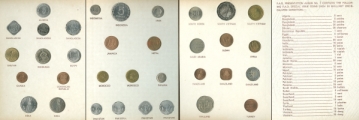
Concurrently with the Ceres medals struck by FAO, Central Banks and Ministries of Finance are beginning to issue legal tender coins and banknotes on the theme of rural women's advancement.
Nearly 200 million such coins had been issued in ten countries by early 1979, ranging from the portrayal of a woman tractor driver on a 5 shilingi coin of Tanzania to a laboratory worker on a 10 millieme coin of Egypt. Such symbols will surely multiply as Central Banks take account of the actual and potential contribution of women to economic modernization and social life- enhancement.

FAO MEDAL PROCEEDS
All proceeds from the sale of FAO medals are used to finance projects for the social and economic advancement of women
and men in the developing countries. On pages 7 and 8 we describe the first ten such projects devoted to rural women's
advancement.
 
                       Raymond Lloyd
                       FAO Money & Medals Programme


Unknown Year -

      38 mm Silver proofs of these Agricola medals were also minted by a third party on  license from the FAO.

Pope John Paul II has made continuous struggle against hunger and malnutrition and his demonstrated concern for the plight of mankind’s poor, and for peace in the world
King Bhumibol Adulyadej of Thailand has devoted time and energy to improve his subjects’ quality of life, and promote a better rural economy. During his long reign, 1,955 royal initiatives meant to the poor have been developed.
King Fahd Bin Abdul Aziz Al Saud of Saudi Arabia is highly recognised for the extraordinary agricultural development in Saudi Arabia. The King has also made numerous endeavours to assist other developing countries in improving the living conditions of rural people.
Jiang Zemin, the former president of the People’s Republic of China (1993-2003), during his leadership, had given top priority to strengthening agriculture, increasing farmers' income, and consolidating the fundamental status of agriculture.
Jayaprakash Narayan of India had dedicated more than forty years of his life to rural development activities in India, believing that it was not enough that the nation attain political freedom but the true freedom was the freedom from hunger, poverty and ignorance.


A winning combination of thematic designs and exquisite craftsmanship, the FAO - Agricola Medallion Set features five 1-oz dazzling silver medallions, representing the mutual commitment between FAO and GOLDQUEST to overcome hunger and poverty, and serving as a prized collectible that embodies the true spirit of mercy and celebrates the praiseworthy dedication of the five great men, arduously working to build a better world.