This is a restored and revised private copy of site "www.fao-coins.info". The site was originaly created by Arthur Newmark from 2004-2016. After I got the URL I started restoring the pages. I accept every Copyright, so please let me informed if there is some content you own copyright. For contact information visit my private Homepage WWW.FIAT-PANIS.DE
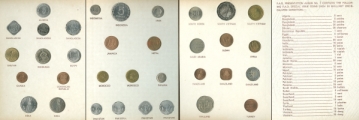
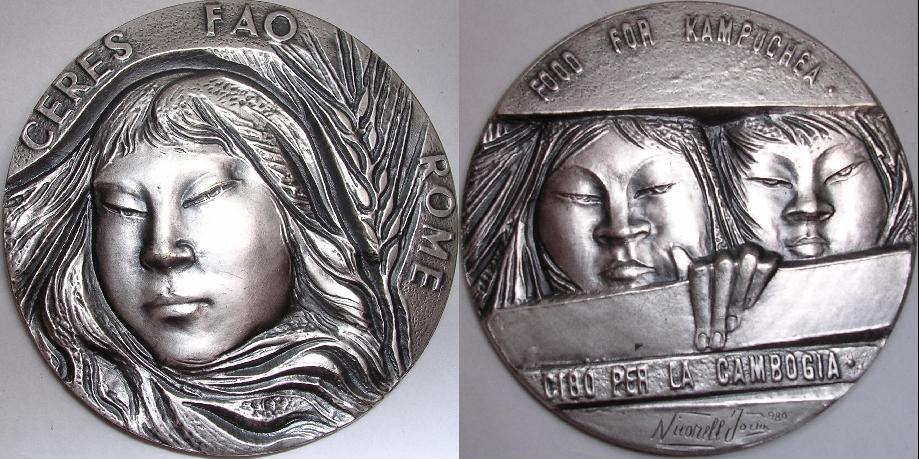
FAO ALBUMS, BOARDS / United Nations Medal Collections
This page arose from my search for a reference on the various collections of Coins and Medals issued in conjunction with the United Nations and the Food and Agricultural Association.
|
NEWS (Old news?) Error piece released in Album 6 & Board 8
For individual coins and contact information see my homepage www.fiat-panis.de (in german language only).
Much of the information on these pages I have copied from Arthur Newmarks homepage, available under fao-coins.info until December 2016, who was contributed by collectors around the world.
I thank those many contributors and welcome additional information on these series.
|
|
Countries Issuing FAO Coins:
The list of countries need to be updated. Please let me know if you are aware of any additional countries that belong on this list.
Afghanistan 1981
Ajman 1970
Algeria 1970
Andorra 1995
Antigua 1970
Bahrain 1969
Bangladesh 1974
Barbados 1970
Belize 1985
Bhutan 1974
Bolivia 1968
Botswana 1976
Brazil 1975
Bulgaria 1975
Burma 1977
Burundi 1968
Cambodia 1973
(Khmere Republic)
Cape Verde 1977
Ceylon 1968
China (Republic) 1970
Comoros 1977
Cook Islands 1979
Croatia Cuba 1981
|
Cyprus 1970
Dominica 1970
Dominican Republic 1969
East Caribbean States 1981
Egypt 1970
Ethiopia
Fiji
Gambia
Germany 2012
Ghana 1979
Grenada 1970
Guernsey 1985
Guinea-Bissau
Guyana 1969
Haiti
Honduras 1973
Hungary 1981 - 1985
Iceland 1981
India 1970
Indonesia 1971
Iran 1970
Iraq
Isle of Man
Israel
|
Italy 1973
Jamaica 1972
Jordan 1970
Korea, Dem. Republic 1995
Korea (South)
Kuwait 1983
Laos 1995 1996
Lebanon 1968
Lesotho 1969
Liberia
Macedonia
Madagascar 1970
Maldives 1973
Mali
Malta
Mauritius
Montserrat 1970
Morocco 1973
Mozambique
Myanmar
Namibia 2000
Nepal 1968
Nicaragua
Oman
Order of Malta 1968
|
Pakistan 1973
Panama 1972
Paraguay 1972
Philippines 1973
Poland 1971
Portugal
Rumania 1995
Rwanda 1970
Samoa (Western) 1970
San Marino 1973
Saudi Arabia 1972
Seychelles 1972
Sierra Leone 1972
Singapore 1972
Slovenia
Solomon Islands
Somalia 1970
South Africa 1995
St. Christopher 1970
St. Helena 1984
St. Lucia 1970
St. Thomas & Principe 1977
St. Vincent 1970
|
Spain
Sri Lanka
Sudan 1968
Swaziland
Sweden 1985
Syria 1968
Tanzania 1971
Thailand 1972
Tonga
Trinidad & Tobago 1969
Tunisia 1970
Turkey 1970
Tuvalu 1985
Uganda 1968
United Arab Emirates 1973
Uruguay 1969
Vanuatu 1983
Vatican 1968
Vietnam 1968
West African Monetary Union 1972
Yemen Arab Republic 1972
Yugoslavia 1970
Zambia 1969 |
Notes
These brochures illustrate the issue prices for the FAO Albums, Boards and medals through 1978.
(Please contact me if you have brochures not listed here.)
1973 Ad
from the Numismatist - Album 2 / Leftover pages from Album 1 - 1973
Money Album 2 - undated, note info on medals - struck London & Paris mints
Collectors Note 1 - 4/4/1972
Collectors Note 2 - 10/24/1972
Collectors Note 3 - 10/16/1972
Collectors Note 3a - 12/6/1973
Money Panels - 10/1/1972
Collectors Note 4 - 12/15/1972 - One page with 1972 prices -
Collectors Note 5 - 3/13/1973
Collectors Note 6 - 6/25/1973
Collectors Note 7 - 9/3/1973
Collectors Note 8 - 10/16/1973
Collector Note 9 - 12/10/1973 - Issue prices for Red pages 3-6, Album 2; Album 3 Prices for pages 4, 5, 6, 9 , 10; Panels 1-3, Ceres Medals
Collector Note 10 - 1/31/1974 - Sixth Ceres medal
Money Panels - 1/14/1974
Money Panel 1A - 11/1/1974
Collector Note 11 - 3/15/1974 - Issue prices for Red pages 3-6, Album 2; Album 3 Prices for pages 4, 5, 6, 9 , 10; Panels 1-3, Ceres Medals
Collector Note 12 - 5/31/1974
Newsletter 13 - 9/1/1974
Newsletter 14 - 10/16/1974 - Issue prices for Red pages; Blue; Green; Medal Panels
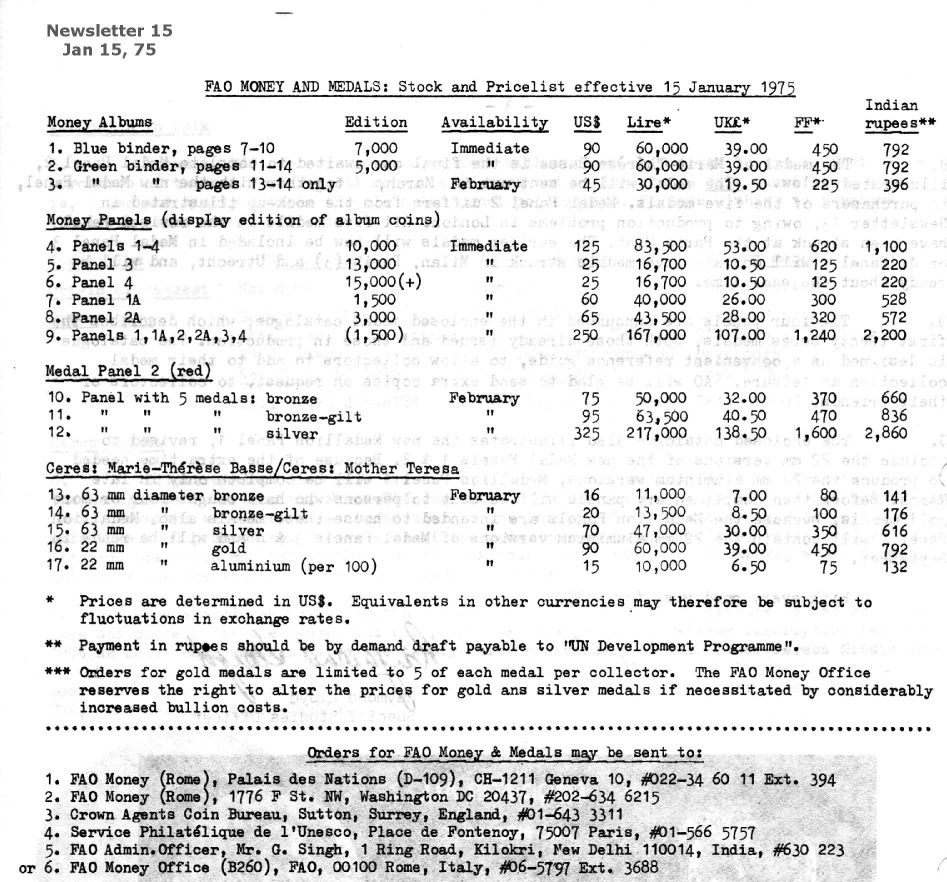
Newsletter 15 - 1/15/1975 - Issue prices for Album 2, Album 3 Money Panels, 1-4, 1A, 3, 4, 2A, 1-4&1A,2A
Newsletter 16 - 7/15/1975
Newsletter 17 - 1/21/1976 - Issue prices for Green Album 3, Grey, Album 4, "FAO Coins of the World" see ¶ 6.
Newsletter 18 - 7/15/1976 - Issue prices for Album 2, Green Album 3, Grey, Album 4, Album 5 Money Panels, 1-5, 1A, 5, 6, 3A, 4A; Ceres medals
Newsletter 19 - 8/30/1976 - Issue prices for Album 2, 3, 4, 5 Money Panels, 1-5, 1A, 5, 6, 3A, 4A; Ceres medals First reference to Panel 1B.
Newsletter 20 - 2/17/1977
Newsletter 21 - 5/20/1977 - Issue prices for Album 3, 4, 5 Panel 1B - issued with only 2 coins @ $25. Money Panels, 1-4, 1-6, 7&8, 3A&4A;1B; Ceres medals
New issues 22 - 8/9/1976 - Tables of Countries & themes by year (77 Countries) (Front page only)
Newsletter 23 - 5/12/1978 - Announcement of Money Panels 10-12 / Red Album 7 - Album 7 was issued with the same 48 coins as Panels 10-12.
Newsletter 24 - 11/15/1978 - Announcement of 3rd series of Ceres & Agricola medals
Newsletter 25 - 6/29/1979 - New Distributor - International Coins and Currency; Montpelier, VT Announcement of 3rd edition of Medals Booklet.
Newsletter 26 - 11/19/1979 - Ceres & Agricola medals
Newsletter 27 - 4/21/1980 - FAO Red Albums - First gold coins; "90 participating countries"
Newsletter 28 - 10/16/1980 - FAO Red Albums I & II
FAO Money Food For All 1968 - (1,5 megabyte pdf - may take some time to download!) A color brochure issued by the MMP coverinng the initial albums and board
1977 Distributors of FAO Money and Medal Pages.
LINKS:
1973 Article
on FAO Coins
1977 Article
on the FAO Money and Medals Program
My Page about FAO Coins (German Language)
.......
FAO Home Page
...
Ben´s FAO Coin Collection
- German Collector Living in Spain - Benjamin Muñiz ; condorcoins ;$$ arrakis; es
German Collector's Page
.Manfred Boehm has illustrated the albums issued from 1968 - 1984. HE had purchased these as they were originally
being issued from FAO headquarters in Rome. I thank him for the wealth of information he has contributed to this page.
Some original order forms with issue prices and planned distribution - courtesy of Manfred Boehm:
Newsletter 15
..
Collector's Note 4
Catalogs:
German FAO coin catalog Written by: Rainer Erdmann; Fulda; Germany Catalog is sold out! Only 500 printed.
World Fao Coin Book - According to Juan - THE work on the subject - I have not bee able to find this book.
FAO Coins International Catalog - by Attilio Armiento - Author sell it at ebay
NEWS !!
Early production error released to FAO in 1977??
SEE
WCN Note
A collector has alerted me that in 1977, the Pobjoy Mint released a small number of 1/2 Pennies struck
for the Isle of Mann, with a "PM" mintmark missing from the reverse.
(The "
normal
" coin has the mintmark on both sides.)
A contemporary roary note in
World Coin News
by A. E. Pobjoy explained that this was due to the striking
of coins with the initial pre-production setting up of dies prior to the circulation mintage.
Clearly, a "pre-production" batch of these pieces was released to the FAO MMP.
It is unclear if any of the "normal" pieces made it into the released collections.
TOP