`     FAO MEDALS    -

              
CERES   MEDALS

  Most of the Ceres Medals were issued groups of 5 as well as individually:.   Page 1 . Page 2 . Page 3  . Page 4Page 5  . Page 6.
       
Several appear to have been issued ONLY individually.
 
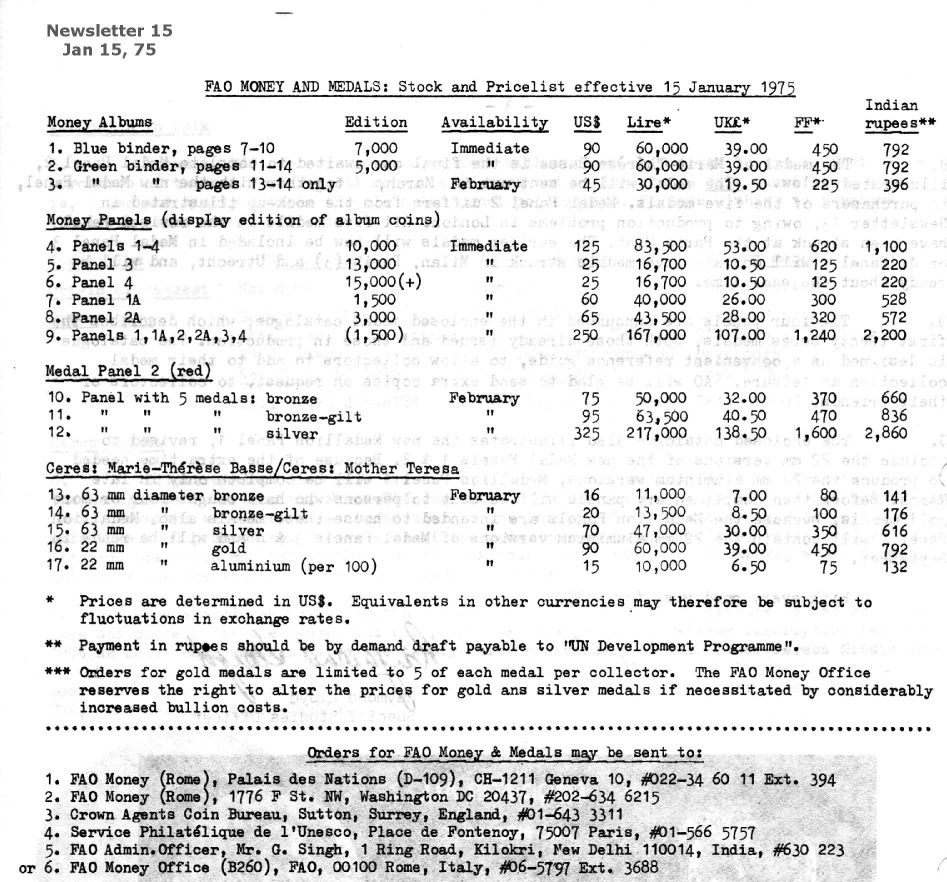
     Issue prices (1977) were was follows:
            Bronze 63 mm  -          $16 - Page of 5:   $75  
            Gilt Bronce 63 mm  -  $20 - Page of 5:   $95  
            Sliver  63 mm  -          $75 - Page of 5:   $425
   "Sovereign" Size (22 mm):
          Gold          $ 90  per medal  - Set of 30 Medals  $ 2250
          Aluminum  $ 15 per 100 medals, Double set showing both sides of each medal in 3 panels - issued at $45  


1977 Statement from Raymond Lloyd  -  Special Studies Officer responsible for the FAO Money and Medal Programme
  Ceres according to ancient Roman beliefs, was  the goddess who taught mankind how to work the land, plant seeds and produce food. As goddess of agriculture, Ceres protected the crops and kept her people from need and want. Today Ceres remains a symbol to the world's hungry people as she takes the face of humane and distinguished women of our own time on Ceres Medals issued by FAO, the Food and Agriculture Organization of the United Nations.

This booklet illustrates the first collection of thirty Ceres medals. They are shown actual size: obverse photos are of the 63mm art medal version and reverse photos of the 22mm sovereign size version. A brief narrative is given for each of the women portrayed on the medals.
Ceres of Today' Immortalized in Precious Metal

The women invited to represent Ceres have all been prepared to go on public record as sharing FAO's ideal of a world freed from hunger and want, although not all are connected directly with food and agriculture. The different Ceres have achieved their distinction in many fields. Some are well known, others less so. Some have received many awards, while the distinction of others has yet to stand the test of time. All have in common a marked joy in life and a reputation for personal kindness, of not having used other individuals in achieving their distinction. Many have great beauty of person, but all have great beauty of personality and achievement.

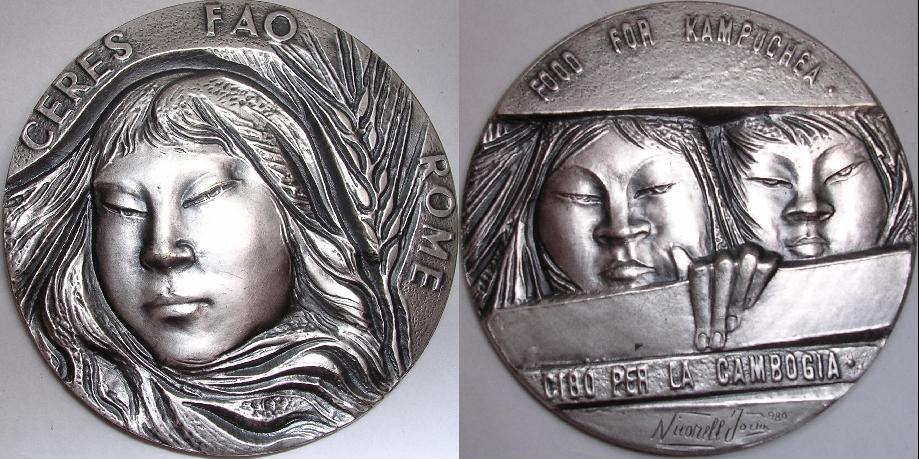
Featured on the obverse of each medal is a finely sculpted portrait of the distinguished woman invited to represent Ceres, with the text "Ceres FAO Rome", her name, the sculptor's signature, and one or more ears of grain. As to the medal reverse, some designs illustrate the person's interest in nutrition, agriculture, social justice or third world development. Other designs feature a milestone in the work of FAO and the UN Family, such as the 1974 World Food Conference or the 25th Anniversary in 1973 of the Universal Declaration of Human Rights. And yet other designs are left to the imagination of the artist, in some way related to the background of Ceres, or representing the sculptor's own aesthetic contribution to FAO's Food for All goal.


FAO MEDALS 1

Indira Gandhi
On this medal Ceres is represented by Indira Gandhi, under whose leadership as Prime Minister great advances have been made in spreading throughout India the benefits of the "green revolution" of high-yielding cereals. The reverse of the medal commemorates the VII World Forestry Congress, held in Buenos Aires from 4 to 18 October 1972. Based on a design by Mario Cassola, Chief of the FAO Graphics Section, the medal shows a tree sheltering a trunk made up of people, with the meridians of a globe to the right and the cross-section of a tree to the left.
Sculptor: Georges Simon  Monnaie de Paris

Sophia Loren
The first Ceres medal was issued in 1971 to commemorate FAO's twentieth year in Italy. Fittingly, the Roman goddess of agriculture is here represented by the distinguished Italianborn entertainer, Sophia Loren, who donated her portrait as an expression of her own belief in FAO's Food for All goal. The reverse design shows twenty ears of wheat superimposed on the meridians of a globe, one for each year of FAO in Italy, with the dates 1951-1971.
Sculptor: Georges Simon Monnaie de Paris

Angela Christian
Since her country's independence in 1957, Angela Christian of Ghana has played an important role in the social and cultural renaissance of West Africa. She has served as information and cultural affairs officer in London, Paris and Washington, and as adviser to the Ghanian delegation to the Social, Cultural and Humanitarian Committee of the UN General Assembly. From 1968 to 1970 she was Head of the Ghana National Freedom from Hunger Committee. While Angela Christian was in London, Sir Jacob Epstein asked permission to model her head. Modestly, she declined, but has donated her portrait to FAO in continuing support of our Food for All ideal.
Sculptor: Manolis Tzobanakis  Bertoni Mint, Milan

Olave Baden-Powell
This medal was released on 10 December 1973, XXV Anniversary of the Universal Declaration of Human Rights, and features Olave Baden-Powell as Ceres. Lady Baden-Powell, World Chief Guide since 1930, has spent over sixty years of her life in the service of young people. In recent years the 6,500,000-strong Guide movement has, in many developing countries, become increasingly involved in nutrition and rural development work. The reverse of the medal shows three girls representative of different developing countries, and symbolizes the shared ideals of FAO and of the Guide movement as expressed in the inscription "Toward Food Education Employment for All."
Sculptor: David Wynne    Royal Mint, London

Coretta  Scott  King
On this medal Ceres is represented by the wife of the late civil rights leader and winner of the Nobel Peace Prize. Mrs. Martin Luther King Jr. was invited to donate her portrait in tribute to her work on behalf of the under-privileged, both at her husband's side from 1955 onward and after his death in 1968. Mrs. King was born and brought up on a farm and has strong roots in the rural southland of her country. The reverse of the medal features the four King children: Yolanda (1954), Martin III (1957), Bernice (1964) and Dexter (1962). The quotation emphasizes the social commitment for which their father hoped to be remembered after his death.
Sculptor: Georges Simon  Monnaie de Paris


FAO MEDALS 2

Germaine  Tillion
Germaine Tillion is a distinguished ethnologist
who played a leading wartime role in the French resistance and has travelled and studied widely in North Africa, the Middle East and the Far East.
This medal was issued to commemorate the most important political meeting ever held on theglobal food situation, the UN World Food Conference, which took place in Rome from 5 to 16 November 1974. The reverse inscription marking the Conference surrounds a North African harvestcharm, woven from ears of wheat and kept in the house as a token of hope for success in the next harvest.
Sculptor: Marcel Chauvenet   Monnaie de Paris

Michele Morgan
Here Ceres is portrayed by the distinguished French actress Michele Morgan, who has donated her portrait for the medal as a token of her own sympathy with FAO's ideals. The reverse is a free interpretation by the late Marceau Bosc, whose previous work for the Paris Mint includes a medal of Dag Hammarskjold, The design shows a French farmwoman with the legend "Against hunger in the world."
Sculptor: Marceau Bosc   Monnaie de Paris

To Feed the World

This was the first idealized portrait of the goddess of agriculture, in which the expression of human faith in FAO's Food for All ideal is chiefly the artist's own. The medal was conceived by Georges Simon, who had previously sculpted for FAO the portraits of three distinguished living Ceres: Sophia Loren, Indira Gandhi and Coretta Scott King. The reverse design is a free interpretation by Mr Simon on the theme "To feed the world."
Sculptor: Georges Simon Monnaie de Paris

Idealized Ceres:  Sonia  Navas
This idealized portrait of Ceres is based on Sonia Maria Navas, a young Nicaraguan economist and daughter of one of FAO's longest-serving members. She appeared earlier as a model on a 1973 Nicaragua 20 centavo postage stamp. The reverse design includes an anchor, symbol of hope; an olive branch, symbol of peace; an ear of wheat; and the meridians of a globe. The reverse inscription reads "The earth has food for all."
Sculptor: Sergio Giandomenico  Monnaie de Paris

Marie-Therese Besse
Marie- -Therese
Marie-Therese Besse is the director of the Institute of Food Technology in Dakar. The Institute's
best known success is the "pain de mil" or millet bread, which has been developed to use a high
proportion of locally grown millet instead of imported wheat flour. The reverse of the medal recalls the Sahel relief operation. The African
countries bordering the Sahara have been seriously affected by drought since 1968, and in 1973 and
1974 the resulting loss of livestock and crops reached crisis proportions. FAD and the World Food Programme have been active in meeting emergency food needs (symbolized by the aircraft dropping supplies) and in setting up new projects
to rehabilitate farmers (symbolized by the artesian we l I ).
Sculptor: Robert Cochet   Monnaie de Paris


FAO MEDALS 3

Mother  Teresa
This medal depicting Mother Teresa has been issued in tribute to her exemplary love for the hungry and the poorest of the poor. The Missionary Sisters of Charity, the order founded by Mother Teresa on 7 October 1950, celebrated its 25th anniversary in 1975. The order presently has77 centres among the poor and hungry in 17 countries, including Australia, Bangladesh, Britain, Ethiopia, India Italy, Jordan, Peru, Sri Lanka, Tanzania, the United States and Venezuela. The medal was designed by the British sculptor Michael Rizzello, who donated his work to FAO. The reverse of the medal recalls 1975 as Holy Year, while the inscription "Food for All" expresses the ideals shared by Mother Teresa and FAO.
Sculptor: Michael Rizzello Royal Mint, London

Matsuyo Yamamoto
The Japanese home economist Matsuyo Yamamoto is the director of the Research Institute for Home-Family-Community Living, and an FAO consultant. A pioneer of rural extension work in Japan Mrs. Yamamoto has since 1948 built up a 360,000-strong movement, Seikatsu-Kaizen, dedicated to the improvement of living conditions of rural families. The reverse shows the movement's symbol, a stylized farmhouse and two hands supporting a flame, representing the torch-light of improvement. The medal design was donated by Mrs. Yamamoto's husband Wakahiko, who is president of the Japan Artists' Association.
Sculptor: Wakahiko Yamamoto   Royal Mint, London

 Iris Murdoch
From 1944 to 1946 Iris Murdoch, the philosopher and novelist, worked for UNRRA, the agency responsible for rehabilitation of countries devastated by war. In donating her portrait for the medal, Iris Murdoch writes: "Xenophon quoted Socrates as saying that agriculture is the mother and nurse of the other arts. It is certain that agriculture is in some important sense the most fundamental of all human techniques and the presupposition of human activity. Hunger can make art and even thought seem frivolous. And in an age when people are starving and we can fly to the moon, one would hope that our vast technical knowledge could be set to work to help all our people at last to feed themselves.̊"
Sculptor: James Butler Royal Mint, London

Kathleen Kenyon
Ceres is represented here by Kathleen Kenyon, the distinguished British archeologist and Red Cross worker who has directed numerous excavations in Britain and the Middle East. The excavations at Jericho in particular have shown how the establishment of permanent settlements is dependent on the development of agriculture. Her work has contributed greatly to an understanding of the beginnings of agriculture some 10,000 years ago, when neolithic women and men first began to plant wheat and barley and to domesticate goats, sheep, pigs and cattle. This theme is featured on the reverse of the medal, on which the inscription "Jericho" is surrounded by a primitive plough and a modern tractor and bale loader.
Sculptor: Ivor Roberts-Jones   Royal Mint, London

Attiya Inayatullah
This medal was issued for World Population Year, 1974, and features as Ceres Dr. Attiya Inayatullah, executive vice-president of the Family Planning Association of Pakistan and vice-chairwoman of the International Planned Parenthood Federation. A sociologist and anthropologist by training, Dr. Inayatullah has taught and lectured widely in Pakistan and abroad, and has been active for many years as a volunteer in the fields of family welfare and population. The medal was sculpted as a donation to FAO's work by the artist, Manolis Tzobanakis. The reverse is based on a design by Paul Greene, Chief of the FAO Visual Presentation Section.
Sculptor: Manolis Tzobanakis   Royal Mint, London

FAO MEDALS 4

Margaret Mead
On this medal Ceres is represented by the distinguished American anthropologist Margaret Mead, who in World War II developed the science of food habits and worked on problems of the cultural setting of nutrition, She participated in the World Population and Food Conferences in 1974 and has underlined the seriousness of the way in which women are being excluded from mechanized agriculture and from policy-making in regard to food. In Dr. Mead's view food is in danger of being viewed more as a weapon or a commodity than as something that human beings must eat to live. The reverse design of the medal is a free interpretation by the artist, depicting Faces of Humankind.
Sculptor: Manolis Tzobanakis  Monnaie de Paris

Shirley' Temple  Black
This portrait of Ceres features Shirley Temple Black, US Ambassador to Ghana, whose career spans forty-five years of public service, including movie-stardom in her childhood, and US representative to the United Nations in 1969. Her special interests include a founding role in UN programmes in the human environment, and in world health, world nutrition and food production centred on the developing countries of Africa and the Middle East. The reverse of the medal shows Ambassador Black with a group of children and bears a quotation from a speech made by her at the 1972 UN Conference on the Human Environment in Stockholm.
Sculptor: Frank Gasparro  Monnaie de Paris

Food for All
This idealized portrait of the goddess of agriculture is sculpted by a leading Italian medallist, Ettore
Calvelli of Milan. The free reverse design features a human allegory of the spirit of the harvest sharing her wisdom with man, hard labour and love provide The inscription reads: "Food for All."
whose intelligence, food for his child.
Sculptor: Ettore Calvelli    Bertoni Mint, Milan

Jacqueline  Auriol
Jacqueline Auriol is a distinguished French pilot who holds many aviation records; she was one of the first women to break the sound barrier and to fly the supersonic Concorde. Madame Auriol, who works at the Ministere de la Cooperation, has donated her portrait for this medal as an expression of her support for FAO's goals. The medal reverse shows a silhouette of the Concorde, as a symbol of technological progress, and illustrates the technique of remote sensing, a new method of gathering information about the earth's resources, for example in locating water for irrigation, in spotting plant diseases and in mapping crop species and types.
Sculptor: Rene Andrei Monnaie de Paris

Irene de Borbon de Parma

Here Ceres is represented by Irene de Borbon de Parma, a member of the royal family of the Netherlands, who has offered her portrait as an expression of her own belief in FAO's ideals. Irene is an active worker on behalf of migratory workers in France, and has made major contributions to the relief of the hungry in West Africa. The medal was sculpted by Philippe Roch, whose reverse design expresses his hope for Food for All in a hungry world.
Sculptor: Philippe Roch   Rijks Munt, Utrecht

FAO MEDALS 5

Dechhen Wangmo Wangchuck
Featured on this Ceres medal is Princess Dechhen
Wangmo Wangchuck of Bhutan who, born on 9 September 1950, is the youngest head of a national Ministry of Development in the world responsible for education, health, agriculture and
public works. Princess Dechhen is also president of the Food Corporation of Bhutan and member of the National Planning Commission. While still at school she founded the National Youth Association of Bhutan of which she is now president.
The reverse design shows two women pounding rice, against a typical Bhutanese background.
Sculptor: Sergio Giandomenico   Bertoni Mint, Milan

 Gloria Steinem
Gloria Steinem, a writer and leading activist in the US women's liberation movement, is a co-founder and editor of MS Magazine, Her writings have focused on social issues such as feminism, minority group problems, and current sociology and politics, and her work has appeared in many journals and newspapers in the US and Europe as well as in India, where she studied and wrote for two years. The reverse pictures five women of different ages and nationalities, symbolizing world sisterhood.
Sculptor: Elizabeth Jones  Bertoni Mint, Milan

Our First Food
The leading Polish medallist Jozef Markiewicz has sculpted an idealized representation of the Roman goddess of agriculture Ceres, portraying the breast of a mother nursing her child. The design, "Our First Food", also appears on a 10 zlotych coin issued in Poland in 1971. The reverse depicts ears of wheat and bears an inscription commemorating FAO's thirtieth anniversary, 16 October 1975.
Sculptor: Jozef Markiewicz  Bertoni Mint, Milan

Aziza Hussein
At national level, the voluntary worker Mrs. Hussein has been active in rural areas by promoting child welfare, family planning and women's rights. At international level, she has served as a member of several UN expert committees, notably the Cornmission on the Status of Women, and is vice-chairwoman of the governing body of the International Planned Parenthood Federation. The medal reverse depicts in modern Arabic calligraphy the ideal of Mrs. Hussein, which in English would read: Every woman has the right to a free and dignified life, in which she can determine her destiny and develop her talents so as to contribute through love and creative work to social progress and peace."
Sculptors: Gamal Sagini (portrait), Abdellah Hariri (reverse)
 Bertoni Mint, Milan

Thangam  Philip
On this medal Ceres is portrayed by Thangam Philip, the principal of the Institute of Hotel Management, Catering Technology and Applied Nutrition in Bombay, the first and largest institute of its kind in Asia. For over twenty years Miss Philip has played a significant role as a food educator, training students in imaginative largescale catering for industry, schools and hospitals, and developing courses for housewives to teach thern nutritionally sound culinary skills. The Bornbay Institute appears above the portrait: to the right is a row of "nan", one of India's most popular breads. The reverse design shows three students and bears the inscription "Food Education Employment for All," recalling the Institute's principal goals.
Sculptor: Vito Berardi   Bertoni Mint, Milan


FAO MEDALS 6

 Julia Ojiambo
This Ceres medal features Dr. Julia Ojiambo, Kenyan nutritionist and home economist who, on her 1974 election to Parliament, was appointed Assistant Minister for Housing and Social Services. Dr. Ojiambo's previous activities include serving as head of the Kenyan Consumers' Association and as 'consultant to FAO Programmes for Better Family Living. The medal reverse reflects her concern with housing, and incorporates the Habitat symbol of the UN Conference on Human Settlements held in Vancouver in June 1976.
Sculptor: Sergio Giandomenico Bertoni Mint, Milan

Alva Myrdal
 Alva Myrdal, former Swedish Minister of State, has contributed greatly to social justice and world peace since the early 1920's, most notably in the areas of development and disarmament. Her objectives have included new dynamic approaches to population policy and family welfare, an educational reform programme, large-scale international development aid and decisive advances in world disarmament. She has served as principal director of the UN Department of Social Affairs, and as Swedish chief delegate to the Geneva Disarmament Conferences. The medal reverse shows wheat growing out of a broken tank, the artist's rendering of Alva Myrdal's lifelong attempt to beat swords into plowshares.
Sculptor: Geoffrey Clarke  London Royal Mint,

Vittoria  Nuti Ronchi
On this medal Ceres is represented by the Italian plant scientist Vittoria Nuti Ronchi, professor of genetics on the Agriculture Faculty of the University of Pisa and chief researcher for the Italian National Research Council. Dr. Ronchi's research deals with nucleic acid synthesis as it relates to the mechanism of tissue differentiation in plants, and her studies on Nicotiana species have led to a better understanding of the underlying factors in tumour formation. Dr. Ronchi has also been active for twenty years in social work on behalf of young women, The medal reverse bears a flask to illustrate her work on plant tissues cultivated in vitro.
  Sculptor: Guerrino Mattia Monassi Bertoni Mint, Milan

Matgot Fonteyn de Arias
On this medal Ceres is represented by the British prima ballerina, Margot Fonteyn de Arias. Dame Margot gained distinction in 1935, at the age of 16, when she became the principal ballerina of London's Royal Ballet. Since 1954 she has been president of the Royal Academy of Dancing. The reverse design depicts the ballerina's hands holding two ears of wheat. The inscription, in Spanish: "XI II Regional Conference, Panama 12-23 August 1974," recalls FAO's biennial Latin American Conference, held in the country of Dame Margot's husband Roberto Arias, who has served as Panamanian delegate to the United Nations.
Sculptor: Vivian Rees-Price  Royal Mint, London

Barbara  Ward
On this medal Ceres is represented by Barbara Ward, the British economist who is one of the world's best known writers on development. Her books include: "Five Ideas that Change the World," 1959; "The Rich Nations and the Poor Nations," 1962; and "The Widening Gap," 1971, Barbara Ward is now president of the International Institute for Environment and Development, set up under her leadership to work for a greater respect and amore equitable distribution of the earth's resources. The medal depicts the earth partially overcome by pollution. The symbol on the medal is that of the UN Environment Programme, set up in 1973 with headquarters in Nairobi.
Sculptor: Jacqueline Steiger  Royal Mint, London

                          TOP


Other Ceres Medals

    - For now I am assuming that the "Ceres" Medals NOT contained in the above six pages wwre issued in 1976 or later.

Fatima Abdel Mahmoud
     I have no information on this medal besides one PICTURE of  a sliver medal
      An Internet  Serach revals the following:
             She was the UNESCO Chair Director For Women, Science and Technology (2003)
               Medical Doctor.